
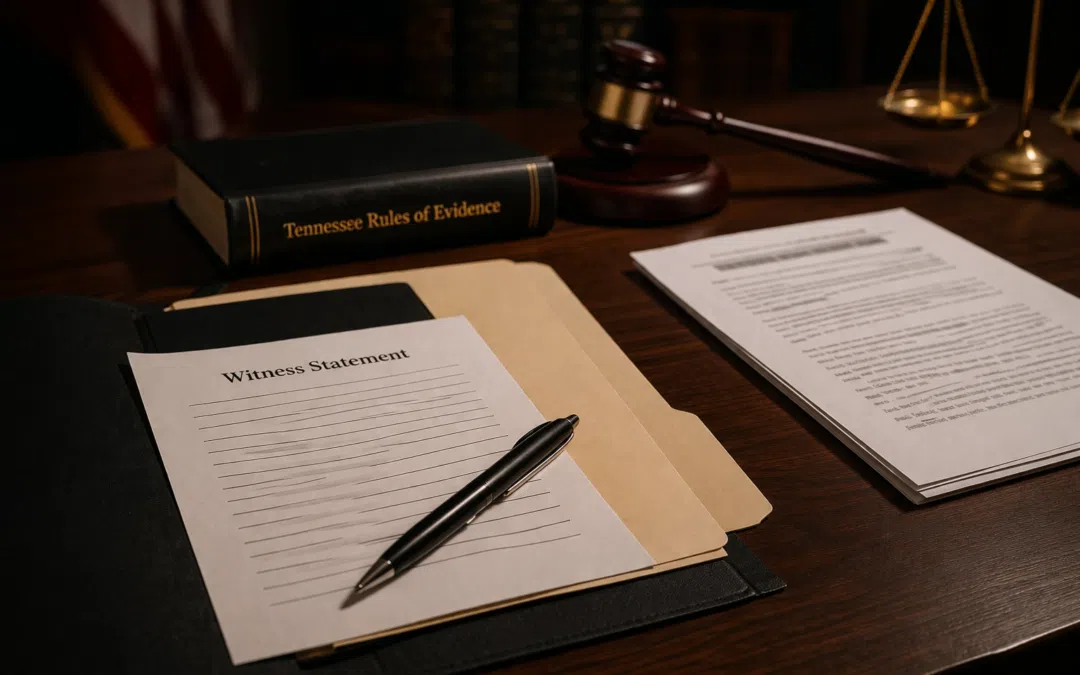
Witness statements often play a central role in how criminal cases develop in Tennessee. From the earliest stages of an investigation through trial, these statements can influence how facts are presented and challenged in court. If you are trying to understand how testimony is evaluated, speaking with a criminal defense attorney in Tennessee can help clarify how these issues are addressed under Tennessee law.
What Is a Witness Statement in a Criminal Case?
A witness statement is a record of what an individual claims to have seen, heard, or experienced in connection with an alleged crime. These statements are often collected by law enforcement during the investigation phase and may later be referenced during court proceedings.
In Tennessee criminal trials, witness statements are not automatically treated as evidence. Tennessee law provides that their use depends on the Tennessee Rules of Evidence, which control how testimony and prior statements may be presented in court.
How Witness Statements Are Used During Investigations
Before a case reaches trial, law enforcement officers typically gather statements from witnesses to understand what may have occurred. These statements may be written, recorded, or summarized in police reports.
At this stage, statements are commonly used to:
- Identify potential suspects
- Establish timelines
- Support charging decisions
These statements often guide the investigation, but they are not always presented directly to a jury in their original form.
Difference Between Witness Statements and Testimony
One of the most important distinctions in Tennessee criminal trials is the difference between a witness statement and courtroom testimony.
A witness statement is usually made outside of court and not under oath. Testimony, by contrast, is given in court under oath and subject to questioning by both sides.
Tennessee law provides that live testimony typically carries greater evidentiary value because the witness must have personal knowledge, testify under oath, and be subject to cross-examination. Out-of-court statements may be limited by evidentiary rules, particularly those governing hearsay.
When Are Witness Statements Admissible in Tennessee Courts?
Not all witness statements can be introduced as evidence during a trial. Tennessee law places limits on the use of out-of-court statements, primarily through the hearsay rules.
Tennessee law provides that an out-of-court statement offered to prove the truth of what it asserts may be considered hearsay under the Tennessee Rule of Evidence 801, and hearsay is generally not admissible under the Tennessee Rule of Evidence 802 unless an exception or another rule applies.
There are situations where statements may still be referenced, such as:
- Prior inconsistent statements used to challenge credibility
- Statements that fall within recognized hearsay exceptions
- Statements offered for purposes other than proving the truth of the matter asserted
Courts closely evaluate how a statement is being used before allowing it to be presented to a jury.
The Role of Credibility in Witness Testimony
Witness credibility is a key factor in any criminal trial. Even when testimony is admitted, the court and jury must determine how much weight to give it.
Tennessee law provides that credibility may be evaluated based on factors such as:
- Consistency of the witness’s statements
- Ability to recall events accurately
- Possible bias or motive
- Demeanor during testimony
Under the Tennessee Rule of Evidence 613, attorneys may question a witness about prior statements that differ from their testimony, which can affect how credibility is assessed.
How Defense Attorneys Challenge Witness Statements
Witness statements are often closely examined by defense attorneys during a criminal case, particularly in violent crime prosecutions where testimony carries significant weight. The focus is on evaluating reliability, consistency, and how the statement was obtained.
For a broader understanding of how evidence is challenged in criminal cases, it is important to consider how attorneys analyze both the content and context of a statement.
Attorneys may examine:
Inconsistencies Between Statements and Testimony
Differences between earlier statements and courtroom testimony may be explored during cross-examination.
Memory and Perception Issues
Human memory can be affected by stress, time, or external influences, which may impact reliability.
Bias or Motive
A witness’s relationship to the case or parties involved may influence their account.
Questioning Methods
Statements obtained through leading or suggestive questioning may raise concerns about accuracy.
Prior Inconsistent Statements and Their Impact
One of the most common ways witness statements are used in Tennessee trials is through prior inconsistent statements.
If a witness testifies differently at trial than they did previously, attorneys may use earlier statements to highlight the inconsistency under the Tennessee Rule of Evidence 613.
A prior inconsistent statement may be used to challenge a witness’s credibility. However, Tennessee law provides that using that same statement as proof of the facts asserted may still raise a hearsay issue unless another rule allows it.
What Happens When a Witness Changes Their Statement?
It is not uncommon for a witness to change or clarify their statement over time. When this occurs, the court does not automatically disregard the testimony. Instead, the change becomes a factor in evaluating credibility.
Tennessee law provides that the jury may consider:
- The reason for the change
- The timing of the change
- Any external influences on the witness
Attorneys may address these issues during cross-examination to provide context.
Are All Witnesses Allowed to Testify?
Not every person who provides a statement will necessarily testify in court. Tennessee law establishes standards for witness competency.
Under the Tennessee Rule of Evidence 601, every person is presumed competent to be a witness unless the rules or a statute provide otherwise. In practice, this works together with other rules requiring that a witness have personal knowledge of the matter and testify under oath or affirmation.
Courts may evaluate competency in certain situations, including issues related to understanding, communication, or perception.
The Difference Between Police Statements and Trial Evidence
Statements collected by law enforcement are often less formal than courtroom testimony. They may be summarized, paraphrased, or influenced by the way questions were asked.
By contrast, testimony at trial:
- Is given under oath
- Requires personal knowledge
- Is subject to cross-examination
Because of these differences, courts generally place greater emphasis on testimony presented in court rather than informal statements gathered during an investigation.
How Witness Statements Fit Into the Larger Trial Process
Witness statements are only one part of the broader evidentiary process in Tennessee criminal trials. Courts evaluate multiple forms of evidence together, including physical evidence, expert testimony, and documentary records.
For additional context on defense strategies in Tennessee criminal cases, it is helpful to understand how attorneys assess all forms of evidence collectively rather than in isolation.
Why Witness Statements Do Not Always Decide a Case
While witness statements can be influential, they are rarely the sole factor in determining the outcome of a criminal trial. Tennessee law provides that all evidence must be considered together.
Courts and juries may evaluate:
- Consistency across all evidence
- Reliability of each source
- Applicable evidentiary rules
A single statement is typically weighed alongside the full body of evidence presented during the trial.
FAQ: Witness Statements in Tennessee Criminal Trials
What is the purpose of a witness statement?
A witness statement provides an account of events that may assist investigators and the court in understanding what occurred in a case.
Can a witness statement be used as evidence in Tennessee?
Tennessee law provides that statements may be used depending on evidentiary rules, including hearsay limitations and recognized exceptions.
What if a witness gives different statements at different times?
Differences between statements may be examined during cross-examination and may affect how credibility is evaluated.
Do witnesses have to testify in court?
Tennessee Rule of Criminal Procedure 17 allows subpoenas for witness attendance, but a person’s obligation to testify may still depend on legal protections, privileges, and court rulings.
Are police reports the same as witness testimony?
No. Police reports often summarize statements, while testimony is given under oath and subject to questioning in court.
Can a case rely only on witness testimony?
Tennessee law provides that courts evaluate all evidence together. Witness testimony may be one part of that analysis.