
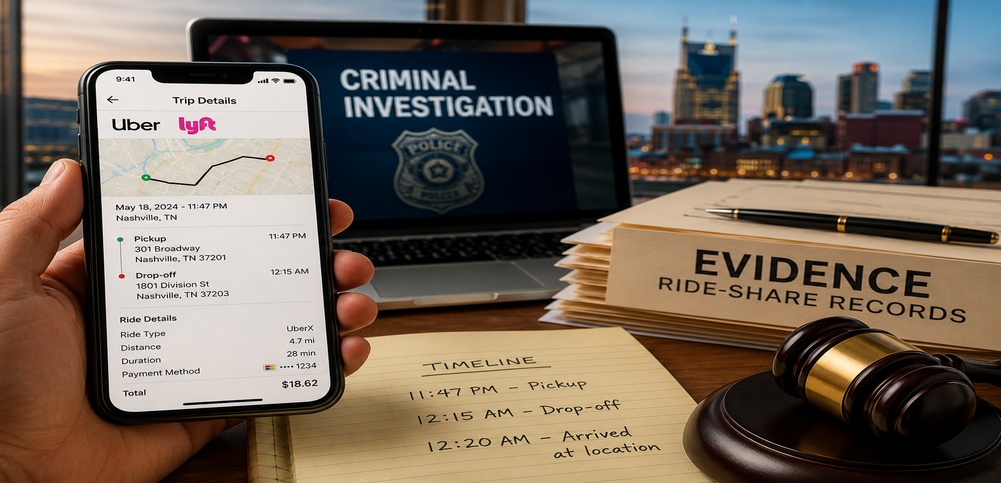
This issue can come up after a night downtown, a DUI investigation, an assault allegation, a domestic incident, a theft report, a hit-and-run accusation, or a claim that someone was at a specific location at a specific time. Ride-share records may show dates, times, pickup points, drop-off points, payment details, account information, or communications connected to the ride, depending on the records kept and the lawful process used to request them.
Still, ride-share records do not automatically tell the whole story. A trip receipt may show that a ride happened, but it may not explain who was present, what happened before the ride, what happened after the ride, or why someone went to a location.
Can Police Get Uber or Lyft Records in Tennessee?
Law enforcement may seek ride-share records at different stages of a case. Before charges are filed, investigators typically rely on a search warrant, a grand jury subpoena, or a direct request through the company’s legal-process channel. Once a criminal case is pending in court, Tennessee Rule of Criminal Procedure 17 allows a subpoena ordering production of books, papers, documents, or other objects. Prosecutors or parties may also seek records through court process in a criminal case. The exact method can depend on the type of record requested, the stage of the case, the company involved, and the connection between the records and the alleged offense.
Under Tennessee Rule of Criminal Procedure 17, a subpoena may order production of books, papers, documents, or other objects. Under Tennessee Rule of Criminal Procedure 41, a magistrate may issue a search warrant for evidence of a crime when the rule’s requirements are met.
Because Uber and Lyft are based outside Tennessee, investigators often reach their records through federal legal process as well. The federal Stored Communications Act governs how companies that store electronic account and location data may respond to subpoenas, court orders, and search warrants. Depending on the type of record sought, this can mean the request comes through a federal channel, a grand jury subpoena, or the company’s own legal-process procedures, in addition to or instead of a state court subpoena or warrant.
That does not mean ride-share records are automatically available to investigators. The scope of the request, the type of data sought, the legal authority used, and the connection between the records and the alleged offense may all matter.
If police are asking about a ride-share trip connected to a criminal accusation, speaking with a Nashville criminal defense lawyer can help you understand how the records may fit into the larger investigation.
What Types of Ride-Share Records Might Police Look For?
Uber or Lyft records may include more than a basic receipt. Depending on the company’s records, the account involved, and the lawful request, investigators may look for information such as trip dates, request times, pickup locations, drop-off locations, route information, driver details, rider account information, payment details, cancellation records, app-based messages, call logs routed through the app, and receipt history.
Investigators may also compare ride-share records with other evidence. For example, they may compare a pickup time against a 911 call, a bar receipt, hotel video, body camera footage, a witness statement, or phone-location information.
The important point is context. A ride-share record may be useful, but it is usually one piece of a larger evidence picture.
Why Uber or Lyft Records Matter in Nashville Criminal Cases
Ride-share evidence can matter in Nashville because many criminal investigations turn on movement, timing, and location. A person may leave Broadway in a ride-share after drinking. Someone may use Lyft to leave an apartment after an argument. A person accused of theft may have a ride receipt showing when they left a store, hotel, or private residence. A witness may claim someone was present at one location, while the ride-share record points somewhere else.
In some cases, investigators may believe the records support the accusation. In other cases, the records may help the defense challenge an incomplete or inaccurate timeline.
For example, if a person is accused of driving under the influence, a ride-share receipt may support the claim that the person used a ride instead of driving. If a person is accused of being present during an assault, a ride-share record may show that the person left before the alleged incident. If a person is accused of making a false statement, the record may help explain a timeline mistake instead of intentional deception.
Ride-Share Records Can Help the Defense Too
People often assume digital records only help the prosecution. That is not always true.
Uber or Lyft records may help the defense by showing that a person was somewhere else, left before the alleged conduct happened, did not drive after drinking, used a ride-share instead of a personal vehicle, or had a timeline that conflicts with an accusation. Ride-share records may also show that investigators focused on one part of the timeline while missing nearby facts.
A single receipt may not end a case. But it can point defense counsel toward other useful evidence, such as surveillance video, phone records, parking records, restaurant receipts, hotel logs, apartment access records, or witnesses who saw the person leave.
This is why preserving the record early can matter. If you are under investigation, do not delete app data, receipts, emails, or screenshots connected to the ride.
Can a Ride-Share Record Prove You Were Somewhere?
A ride-share record may suggest that an account was used for a trip at a certain time, but it may not prove every fact investigators want to infer from it.
A pickup location may not prove exactly where a person was standing before the driver arrived. A drop-off point may not prove what the person did after exiting the car. An account record may not prove who physically entered the vehicle if more than one person had access to the phone or account. A receipt may not prove intent, identity, or guilt.
This is a common problem with digital evidence. It can look precise because it has timestamps and locations, but the legal meaning depends on the surrounding facts.
Courts have also examined how much constitutional protection applies to location data held by third-party companies. In Carpenter v. United States, the U.S. Supreme Court held that historical cell-site location records generally require a warrant. That reasoning has led courts to consider similar protections for other records that reveal a person’s movements over time, which can include ride-share trip data.
Can Police Ask You About Your Uber or Lyft Trip?
Police may ask questions about a ride-share trip during an investigation. They may ask where you went, who was with you, why you took the ride, what time you left, or what happened before and after the trip.
The risk is that people often guess. They may estimate times, forget a stop, mix up locations, or try to explain something from memory before reviewing the actual records. Later, if the app data does not match the statement exactly, investigators may view the difference as important.
Before giving a detailed statement about a ride-share trip, it may be wise to speak with a criminal defense attorney in Nashville, especially if police are comparing your statements with app records, witness accounts, driver information, or surveillance footage.
What If the Records Do Not Match What You Told Police?
A mismatch between your memory and the ride-share record does not automatically mean you committed a crime. People make mistakes about time, location, sequence, and details, especially during stressful events or late-night situations.
But a mismatch can still create problems during a criminal investigation. Police may believe the inconsistency matters. Prosecutors may try to use the difference to challenge credibility. A minor mistake can become more serious if the person keeps explaining without reviewing the evidence first.
A defense lawyer may compare the ride-share record against other materials, including police reports, dispatch records, body camera footage, videos from nearby businesses, phone data, receipts, and witness statements. The goal is to understand the complete timeline, not just one app entry.
Are Uber or Lyft Records Automatically Admissible in Court?
No. Ride-share records are not automatically accepted by a court just because investigators obtained them.
Tennessee courts apply evidence rules when records are offered in a criminal case. Tennessee Rule of Evidence 901 addresses authentication, meaning there must be enough evidence to support a finding that the item is what the proponent claims it is. Tennessee Rule of Evidence 803 includes a business-records exception for records of regularly conducted activity if the rule’s requirements are met. Tennessee Rule of Evidence 902 also addresses self-authentication for certain certified records.
In plain language, the party offering the ride-share record may need to show that the record is genuine, reliable enough under the applicable rule, and connected to the issues in the case. The defense may review the foundation, scope, completeness, and meaning of the record.
What If the Records Were Obtained Through a Flawed Process?
The process used to obtain ride-share records can matter. If a warrant, subpoena, or other request was flawed, defense counsel may review possible objections, motions, or limits on use.
Tennessee Rule of Criminal Procedure 41 addresses search warrants and includes procedures connected to motions involving unlawful or invalid searches and seizures. If evidence was obtained through an unlawful or invalid search or seizure, a defense lawyer may evaluate if a motion to suppress is available under the facts of the case.
This does not mean evidence will be excluded in every situation. Suppression issues depend on the record, the legal process used, the facts presented to the court, and the judge’s ruling.
Can the Defense Get Uber or Lyft Records?
In some cases, the defense may also seek ride-share records. This may be important when the records support an alibi, contradict a witness, show that a person did not drive, or reveal that the police timeline is incomplete.
Under Tennessee Rule of Criminal Procedure 16, upon a defendant’s request, the state must permit inspection and copying of certain documents and objects in the state’s possession, custody, or control if the rule’s requirements are met. If the prosecution has ride-share records it plans to use, or if the records are material to preparing the defense, discovery may become important.
The defense may also investigate independent sources of timeline evidence. This can include the ride-share app, email receipts, bank records, text messages, phone data, photos, video, and witnesses.
What Should You Do If Police Ask About Your Ride-Share Records?
Do not delete Uber or Lyft records. Do not erase receipts, emails, screenshots, or app history. Do not contact the driver to ask them to change a story or explain something for you. Do not message other witnesses in a way that could be viewed as pressure or coordination.
It is also important not to guess. If you do not remember the exact time, route, pickup point, or destination, avoid filling gaps from memory. A confident but inaccurate statement can create new problems.
Instead, preserve what you have. Save ride receipts, payment records, screenshots, emails, and any messages connected to the trip. If police are contacting you about the ride, speak with a Nashville criminal defense attorney before making detailed statements.
Ride-Share Evidence Is Only One Part of the Case
Uber and Lyft records can be powerful because they appear objective. They show times, locations, and account activity. But criminal cases are not decided by app records alone.
The larger question is how the ride-share record fits with the rest of the evidence. Does the police report match the trip timeline? Do witness statements conflict with the app data? Does video show the person entering or exiting the ride? Do phone records support or weaken the timeline? Did investigators request all relevant records, or only the part that seemed useful to the accusation?
These questions matter because digital evidence can be misunderstood when it is viewed in isolation.
Final Thoughts
Police may seek Uber or Lyft records during a criminal investigation in Tennessee, and those records can affect how investigators view timing, location, identity, and credibility. But a ride-share record does not automatically prove what happened before, during, or after a trip.
If police are asking about your ride-share history, or if you believe Uber or Lyft records could help your defense, preserve the records and avoid detailed statements until you understand the legal risk. The context around the trip may matter as much as the trip itself.
Frequently Asked Questions
Can police get my Uber records in Tennessee?
Police may seek Uber records through lawful investigative process. The type of process depends on the record requested and the stage of the investigation.
Can police get my Lyft records during a criminal case?
Lyft records may be requested during a criminal investigation or court case. The legal effect of those records depends on how they were obtained, authenticated, and used.
Can a ride-share receipt prove I did not drive?
A ride-share receipt may help support that argument, but it may not answer every question. The receipt should be reviewed with other evidence, including timing, witness statements, and any allegation involving a vehicle.
Can Uber or Lyft records help prove an alibi?
They may help if the records show timing or location information that conflicts with the accusation. Other evidence may still be needed to give the record full context.
Should I delete ride-share records if police are investigating me?
No. Deleting records can create more problems and may remove information that helps your defense. Preserve the records and speak with a lawyer before taking action.
Are ride-share records always allowed in court?
No. Courts may consider authentication, hearsay, relevance, completeness, and other evidentiary issues before records are admitted.
What should I do if police ask me about an Uber or Lyft trip?
Do not guess about details. Preserve the records, avoid contacting witnesses about the investigation, and consider speaking with a criminal defense lawyer before giving a detailed statement.
This article is for general informational purposes only and does not constitute legal advice. Reading this content does not create an attorney-client relationship. Every case is different, and you should speak with a licensed Tennessee attorney about your specific situation.